


Meditation for the Second Sunday after Pentecost: the call of the apostles
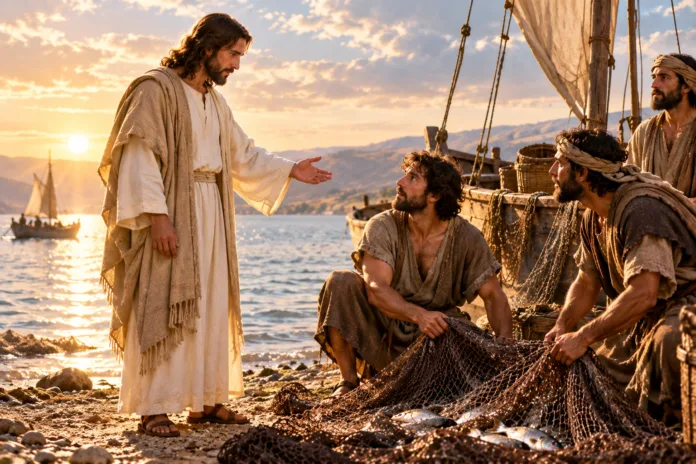
“I will make you fishers of men” (Matthew 4:18-23)
This Gospel passage tells of the beginning of Jesus’ preaching. It shows how Jesus called disciples and helpers to launch his mission. He calls them to found his Church with them and carry out his work on earth through them, especially after his Ascension. That is why the apostle Paul cries out, “How can they believe if they have not heard? And how can they hear unless someone preaches? And how can anyone preach unless they are sent?” (Romans 10:14-15)
These plain words of the apostle Paul, and before them Jesus’ call to the disciples, lead us to think and meditate deeply on some important questions: What is a vocation, and to whom is it addressed? How and where do we receive or hear the call? Is our vocation one and the same for all, or varied? And finally, what is our personal answer to all these questions?
To some people, a “vocation” seems to be a special gift God gives to a group of “chosen ones,” and one of great loftiness and holiness besides. Both ideas easily lead us to think it isn’t meant for us! At best we may see our role in the Church as carrying out the duties that keep us in the ranks of the committed, or in the ranks of those who encourage the chosen ones to accept God’s call.
The call is for everyone! This is a truth we must acknowledge. The Lord’s parables are clear: the parable of the sower, who sows equally on every kind of ground, on rock as on good soil; and the parable of those invited to the wedding and the banquet… show that the call is addressed equally to all.
The Lord Jesus makes it clear that “many are called, but few are chosen” (Matthew 22:14). The difference is not because of the one who calls (the Lord) but because some of those invited refuse their Master’s call. The Lord cannot set aside different calls in advance. The difference exists, but not in God’s call: it lies in the response of those called. God calls everyone, and this is what we call in the Church the common royal priesthood. On the day we are baptized and anointed with holy chrism, we declare fully before the Church that we have accepted this call and become “a holy nation, a royal priesthood.” This is how the apostle Paul addresses the Romans in his letter, calling them “called to be saints” (Romans 1:7). Christian life is by nature a vocation, because it is life in the Spirit, and the Spirit leads us wherever he wills.
The call is addressed to us and to everyone! But many people often lack any sense or awareness of it. We sense the call and pay attention to it when, at some moment, a face-to-face encounter takes place between God and us, so that at that moment we no longer speak of God as “he” but address him as “you.” We face our forgotten vocation when God, at some moment, begins to take his true place within us, and we know him in the greatness of his mystery and mission, and realize that we have a role in his mission because he chose to place it on our shoulders. The Lord Jesus is “the one who sends.” He sent everyone he met after his resurrection. All the appearances of the risen Jesus were encounters of sending.
Recognizing our true role as “called ones” in the Church awaits that moment of awareness. This is what the word “Church” means in the original language: the community gathered in response to the Master’s call.
There are, in fact, special and direct calls that we know from biblical history, such as the call of Paul, whom the Lord wanted as “a chosen instrument to carry my name before the Gentiles” (Acts 9:15), and the distinctive calls of certain prophets such as Moses, Isaiah and Jeremiah, and later of certain saints. These calls mean entrusting those called with a special mission at a moment in history when God’s providence sees them as fit to take it on.
But the call to service and to exercising our royal priesthood is a general call that we receive in the Church, take in through our upbringing, become aware of in catechesis, and take responsibility for at the moment we decide, and realize, that we are not just members of the Church but responsible within it, under God’s watchful eye. That is how the apostles appointed seven deacons when they saw the need: they chose them from among those of good reputation, without these seven receiving any direct “call” from heaven. Is there any call to service addressed to a Christian stronger than sensing the Church’s need for servants, and our own need to live our faith fully and not partially? So it was with the servants of the Temple in the Old Testament, the tribe of Levi, who inherited their vocation by descent and not through unique divine calls.
When does God call us? It’s a strange question. God has already called us, along with everyone else. The real question is: when do we become aware of God’s call? We become aware of it when a sense of responsibility stirs us, when the Church’s need awakens our zeal, and when God’s love wrests our decision from within us and overcomes all hesitation.
In general, we are the ones who call ourselves, in the sense that the call is free and addressed to all. That is, we are the ones who do not refuse the Master’s call and who accept his invitation. There is no “prior selection” or picking out. We choose ourselves, if we want to. And then we cry out like Thomas, “My Lord and my God,” and God is no longer just God, but “our God.”
And if we are all called, we must pay attention to the variety of gifts within the call. Everyone is called to be holy and consecrated to the Lord in their royal priesthood, but there are many paths to this. The apostle Paul lists the various gifts in the one Body of Christ, saying that God made some teachers and some prophets… all for the service of the one Body. That is why, alongside the royal priesthood, there is the ministerial priesthood.
In the royal priesthood a person gives all his heart. In the ministerial priesthood he gives, in addition, all his time and his whole life.
In today’s encounter between the Lord and the first disciples, who were fishermen, he said to them, “I will make you fishers of men.” What really changed was not the trade but the purpose. That is why Jesus deliberately tells fishermen that they will become fishers of men. The emphasis is not on the trade (here, fishing) but on the purpose: people take the place of fish.
All the trades we Christians practise are like nets. If we work at our trade for ourselves, we are fishers of fish; but if we are apostles in our trades and our work, we become fishers of men. The purpose of work in Christianity is not only to meet needs and secure our lives, but above all to be servants and witnesses of the Lord in our work.
All kinds of work are nets for catching people for God. Among them, in particular, is “the priesthood,” a gift we choose, which is one kind of net. We have no choice about whether to be witnesses or not! The choice lies in deciding how we witness to the Lord and in choosing a life’s work that makes that happen.
The ministerial priesthood holds a special place in the Church because of its nature as a living, strong net. The priesthood is not the only path of consecration, but it is the foremost path of consecration. We must not think that someone who does not choose the priesthood as his life’s service is not consecrated. And at the same time, if we sense that the paths of consecration are many and that we can serve the Lord through our work, we must not diminish the importance and uniqueness of the priesthood as a life of service. The choice is free, and freedom calls for the dignity of the children of God.
“The harvest is plentiful, but the labourers are few” (Matthew 9:37): this verse, along with others, kindles in us a sense of commitment to take up the responsibility of service in the Church, not only through our trades and work, which is a blessed service, but also by freely choosing the particular gift, moved by the Church’s needs, people’s needs and their thirst for the divine Word.
The call is for everyone, and our “yes” to it is possible in many ways. Even so, the Spirit sometimes sets on fire young people and souls who, in a blessed moment, want to say to the Master, “Lord, see, we have left everything and followed you” (Matthew 19:27), and repeat Peter’s words: “To whom shall we go (and what shall we do)? You have the words of eternal life” (John 6:68).
Amen.
Father Gerard Abi Saab


 This Gospel passage tells of…)