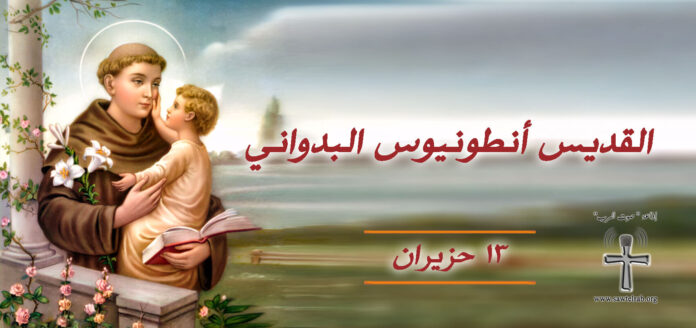
Saint Anthony of Padua
Saint Anthony was born in Lisbon to a noble family around 1195, and was baptized with the name Fernando. He joined the Canons Regular, who followed the Rule of Saint Augustine, first at the monastery of Saint Vincent in Lisbon and then at the monastery of the Holy Cross in Coimbra, a renowned cultural centre in Portugal.
He devoted himself diligently and steadily to the study of Sacred Scripture and the Fathers of the Church, acquiring a theological knowledge that bore fruit in his teaching and preaching. It was in Coimbra that the event occurred which radically changed his life: in 1220 the relics of the first five Franciscan martyrs, who had gone to Morocco and been martyred there, were displayed. The news kindled in the young Fernando the desire to follow in their footsteps and to give himself on the path of Christian perfection. He therefore asked to leave the Augustinian Canons and join the Friars Minor. His request was granted; he took the name Anthony and he too set out for Morocco, but divine Providence had other plans. Struck by illness, he had to return to Italy in 1221, where he took part in the famous “Chapter of Mats” in Assisi and met Saint Francis. Afterwards he lived for a time completely hidden in a friary near Forlì in northern Italy, where the Lord called him to another mission.
Invited by chance to preach at a priestly ordination, he showed such learning and eloquence that his superiors assigned him to preaching. So began, in Italy and in France, an intense and fruitful apostolate that moved many people who had drifted away from the Church to retrace their steps. He was also one of the first teachers of theology among the Friars Minor, perhaps the very first. He began teaching in Bologna with the blessing of Francis, who, recognizing Anthony’s virtues, sent him a short letter that opened with these words: “I am pleased that you teach theology to the brothers.”
Anthony laid the foundations of Franciscan theology, which other great figures would develop and which would reach its peak in Saint Bonaventure of Bagnoregio and Blessed John Duns Scotus.
Having become Provincial Superior of the Friars Minor in northern Italy, he continued his preaching ministry, alternating it with his duties of governance. When his term as Provincial ended, he withdrew to Padua, which he had visited several times before. About a year later, he died at the gates of the city on June 13, 1231.
Padua, which had welcomed him with affection and veneration during his lifetime, has honoured him with lasting devotion ever since. Pope Gregory IX, who had heard him preach and called him the “Ark of the Testament”, canonized him in 1232 after miracles obtained through his intercession.
The Church celebrates his feast on June 13.