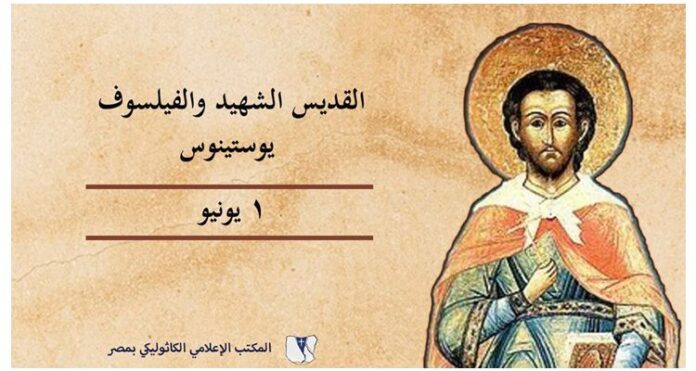
Saint Justin, Philosopher and Martyr
Saint Justin was born around the year 100 in Flavia Neapolis in Samaria, today’s Nablus. His father and grandfather were pagans of Greek origin, and he was brought up in the pagan religion.
From childhood he was inclined to deep thought and to the search for God and the origin of the world. His soul was hungry and thirsty for light and truth. He became the student of a Stoic philosopher, a follower of Zeno, but his teaching did not satisfy Justin’s mind, so he left him and followed another philosopher, a Peripatetic, who began haggling over the fee for his lessons, which made Justin despise him. He kept searching for knowledge to satisfy his mind until he found a Platonist philosopher, to whom he became attached and whom he loved.
While he was absorbed in his thoughts, he met a venerable old man whose face showed attractiveness and gentleness; he looked like a philosopher who had found rest in his philosophy. He greeted Justin and began discussing philosophy with him, and showed him that the Platonic philosophy he admired was incomplete and had no effect on his moral life. Justin asked him, eagerly and in surprise: “Where then shall I find the truth, if not among the philosophers?”
The old man answered: “Long before the philosophers, in ancient times, there lived blessed and righteous men, men of God who spoke by his Spirit, called prophets. They passed on to people what they had heard and learned from the Holy Spirit. They worshipped God the Creator, the Father of all things, and they worshipped his Son, Jesus Christ. Seek, and the gates of light will open to you.”
After saying this, the old man disappeared. He made a deep impression on Justin, who turned to the prophets, and beyond them to the eternal Word, Jesus Christ; from then on Justin became his faithful witness.
He then devoted himself to reading the books the unknown old man had pointed him to, and concluded that Christian philosophy was the only one that could satisfy his mind. He believed in Christ and was baptized. From then on he began the true life of a philosopher, as he himself says. He always regarded Platonic philosophy as a preparation of the pagan world to receive Christianity. So Justin, as a Christian, never stopped valuing philosophy; even after his conversion he continued to wear the philosopher’s cloak, and not in order to avoid appearing as a disciple of Christ. He says of himself: “I have set aside all vain human desires, and my glory now is to be a Christian; there is nothing I desire more than to face the world as a Christian.”
When illness came upon him, he was wonderfully prepared to carry out a fruitful mission, and became one of those true comforters who have learned from their own experience of suffering how to comfort others. Not for a single day did he forget his deep responsibility to bear witness to the truth, toward Jews, pagans and heretics alike.
So Justin dedicated himself to spreading and defending the Christian religion. He went to Rome, where he opened a school; he used philosophy as a means of preaching and defending Christianity. He often met with Jews and pagans wherever he found them, and with heretics as well, and in these discussions he showed remarkable patience and steadfastness.
He left many writings, among them the Dialogue with Trypho (142 chapters), a debate with a moderate Jew eager for knowledge whom he had met in Ephesus. He addressed his First Apology (68 chapters) and his Second Apology (15 chapters) to the Emperor Antoninus Pius and his sons; the first was probably written around 150. His defence was full of courage, dignity and humanity.
Saint Justin was martyred in Rome around 165. The reason for his martyrdom may have been the public defeat he inflicted before a crowd on a false philosopher named Crescens, who soon denounced him to the authorities. Justin was brought to trial on the charge of being a Christian and was beheaded together with six companions.
Prepared by Rita, of the Sawt el Rab team