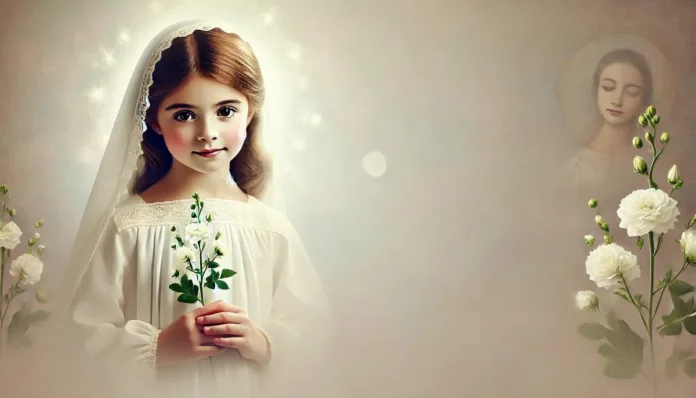
Saint Maria Goretti, Who Gave Her Life for Purity
Maria Goretti was born in Italy, near the town of Corinaldo, on October 16, 1890. She was baptized the next day, October 17, and consecrated to the Immaculate Virgin Mary.
She was one of the six children of Luigi Goretti and Assunta Carlini.
Driven by hunger, the Goretti family moved to Ferriere di Conca, near Nettuno, where they rented a farm in a marshy area infested with mosquitoes. The Gorettis shared the farm with the Serenelli family, who lived upstairs: a widower named Giovanni and his son Alessandro.
Alessandro had been badly brought up, with blasphemy, no prayer and no morals. His days were filled with drinking, giving orders and swearing. On May 6, 1900, Maria’s father died.
Maria helped her mother a great deal. She never complained about the work she was given and often repeated: “Jesus will help us.”
The older she grew, the more she longed to receive Christ in the Eucharist. She said: “I long for Jesus.”
Yet she could not read or write, so how could she learn her catechism?
The priest and a lady from the village helped her. She learned very quickly, and a few months later she passed her examinations.
On June 6, 1901, the feast of Corpus Christi, came the blessed day of her First Holy Communion. Maria was full of love; her face reflected great innocence, purity and piety. A wall of love for God surrounded her. She was devout, but certainly not naive.
Maria went to Communion whenever she could. Yet disaster was approaching. The Serenelli family used the same kitchen to prepare their meals, and Alessandro constantly harassed Maria with his wicked and repulsive demands. Maria hated sin, the devil and weakness, and the virtue that shone from her was purity; she seemed like a lily come down from heaven. She prayed: “Take me, Jesus; I offer myself to you.”
As Maria grew into a young girl, she looked older than her age: at twelve she seemed fifteen. Alessandro behaved like a tyrant in the house and handed out work as he saw fit. To keep the peace at home, Maria’s mother Assunta put up with his behaviour.
He then began treating Maria kindly and flattering her to get what he wanted. The children were afraid of him, but Maria understood why he was acting this way with her; she was certain of his lies, his hypocrisy and his impurity.
This big young man, whom no one dared to stand up to, was stung by Maria’s answers when he made clear what he wanted from her. Maria, deeply upset, cried out: “No, never! It is a sin! God forbids it, and we would go to hell for it.”
The next day, July 5, 1902, Alessandro ordered everyone out to thresh beans, and told Maria to stay behind to mend his shirt. The children trembled and wondered: is this a trap?
Maria did not dare disobey Alessandro, and he followed her into the house. There he seized her violently and shouted at her: “Don’t resist me, or I’ll kill you!” Maria screamed for help and fought back fiercely.
Beside himself, Alessandro stabbed her with a knife again and again, fourteen times in all; one of the wounds missed her heart by only a few millimetres.
Maria collapsed in a pool of blood, crying: “Mother, I’m dying! Mother!” But this did not move the monster, who left her there and went away.
Shortly afterwards he came back to make sure she was dead and stabbed her again. Then he went to his room and lay down on his bed as if nothing had happened. After a while Maria gathered her strength and dragged herself to the door to call for help: “Help… help! Alessandro… tried… he’s trying to kill me!” Then she lost consciousness.
When they found her, they took her to the hospital, where she underwent a two-hour operation without any anaesthetic; they feared she would not survive. She suffered terribly, but her lips repeated this prayer: “Jesus, you suffered so much for me; please help me to suffer for you.”
The doctor said to the priest who had been called: “Father, you have found an angel, but I fear we will leave behind a corpse.” Alessandro was arrested an hour after the crime, handcuffed and taken away. The police had to stop the angry crowd from lynching him. Her mother was not allowed to spend the night at her side.
At midnight the priest visited her and told her he would like her to join the Children of Mary. He put the Miraculous Medal on a blue ribbon around her neck and blessed her. Maria kissed the image of the Blessed Virgin on the medal and prayed the words Our Lady had given to Catherine Labouré:
“O Mary, conceived without sin, pray for us who have recourse to you.”
The next morning, Sunday, July 6, 1902, Maria received Holy Communion. It seemed as if the Host were being given to an angel; a natural light shone from her face. She said: “For the love of Jesus Christ, I forgive the one who tried to kill me. Alessandro will join me in heaven, because I have forgiven him and prayed that God will forgive him too. Soon I will meet him face to face!” Assunta was beside her daughter at that moment. Maria looked lovingly at the picture of the Virgin Mary hanging on the wall of her room and whispered: “Our Lady is waiting for me.” A painful agony followed.
On July 6, 1902, at 3:45 in the afternoon, Maria Goretti died kissing the crucifix, at the age of eleven years and nine months. After her death, countless people prayed for her and to her. Many knelt at her grave, and many asked for and received her intercession. On April 27, 1947, the young virgin who gave her life, Maria Goretti, was beatified by Pope Pius XII.
Many came from all over the world to pay her homage. She was given the symbols of purity and martyrdom: the lily and the palm. Her mother Assunta was present that day and met the Pope in the afternoon. Alessandro had been sentenced to thirty years of hard labour.
When he heard in his cell that Maria had been beatified, he laughed scornfully: “If she’s a saint, let her rise from the dead!” But God’s ways are mysterious. Maria appeared to Alessandro in a dream and gave him lilies. When he took the flowers, they turned into bright flames. This was the beginning of his salvation.
When the bishop visited him, Alessandro learned that Maria Goretti had forgiven him, and he was heard to murmur: “She forgave me?” Then he burst into tears. The monster had a heart after all. He went to the priest and confessed his whole crime.
At Christmas 1937 he took the hardest step of his life: he travelled to see Assunta and, in tears, begged her to forgive him. She simply said to him: “If Maria forgave you, why shouldn’t I forgive you?” On Christmas night, Assunta was seen kneeling at the altar rail beside the murderer of her beloved daughter. He later entered a Capuchin friary, where he was given charge of the garden. So the wish Maria Goretti expressed on her deathbed came true. On June 24, 1950, Pope Pius XII declared Maria Goretti a saint, in the presence of Alessandro, her murderer, and her mother. Bishops, diplomats and members of the Roman nobility witnessed it at Saint Peter’s in Rome.
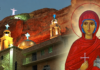
Maria Goretti forgave her murderer before she died. The Church sees her as a model for all virgins and the patron saint of all young women. Her feast day is July 6. Little Maria Goretti is a source of all that is good.
The story of her life was made into an Italian film called “Cielo sulla palude” (Heaven over the Marshes). She is the girl who chose death rather than sin, and through that purity she met the Lord. The Italian Catholic Women’s Union chose her as their patron saint and as a model for all young women. Her body rests in the Shrine of Our Lady of Graces in Nettuno. Today, in a time of moral corruption, unfaithfulness and declining morals, Maria Goretti serves young women and stands for purity and spiritual integrity. Maria Goretti’s holiness does not lie only in choosing death rather than sin, but also in her courage and strength in facing martyrdom, and in the virtues she lived within her family, her spirit of prayer and penance, and her complete devotion to the Virgin Mary and the Eucharist.
Her short prayer is: “Saint Maria Goretti, protect the youth of the world.”