



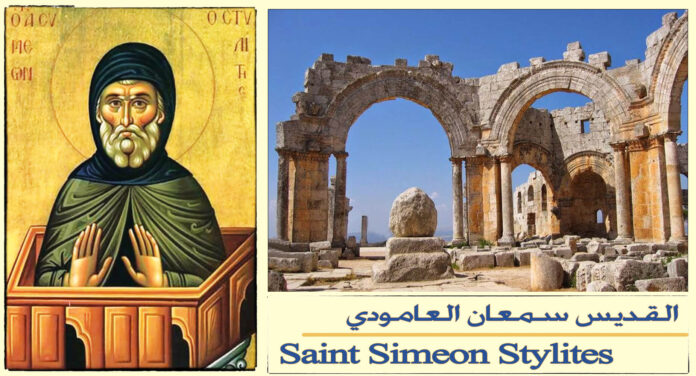
Saint Simeon the Stylite
Saint Simeon was born around 386 in the village of Sis, near Nicopolis (in the Adana region of Turkey). From early childhood he tended livestock. One snowy day, when the flock had stayed in the fold, Simeon went to church with his parents and heard the priest reading the Beatitudes: “Blessed are the meek, for they shall inherit the earth… Blessed are those who hunger and thirst for righteousness, for they shall be satisfied… Blessed are those who mourn, for they shall be comforted… Blessed are the merciful, for they shall obtain mercy… Blessed are the pure in heart, for they shall see God… Blessed are the peacemakers, for they shall be called sons of God.”
Drawn by these words, he joined a group of hermits near Sis. Two years later he moved on to a more perfect life in the area of the great monastery of Teleda, and then went to the monastery of Burj as-Sab’, which had eighty monks. Saint Simeon spent ten years in this monastery in prayer and austerity; he ate only once a week.
In 412 Simeon withdrew to the village of Tel Nisheh, a Syriac name meaning “the hill of women”, which later became Telanissos in Greek (today’s village of Deir Semaan), on the southwestern slope of the mountain where he later spent the rest of his life. He lived in this village for three years as a monk, then shut himself in a cell and kept the forty-day Lenten fast without eating or drinking anything, even though bread and water were beside him.
Saint Simeon then left Telanissos and climbed to the top of the neighbouring mountain, where he lived inside a small circular enclosure. He tied himself with a chain twenty cubits long to limit his movement and restrain his body. Then he had the chain cut, and made do with the vigilance of his conscience as a spiritual bond on his body. Where the chain had been fastened to his leg it left sores in which fleas hid, and he bravely bore their bites for the glory of God.
His fame spread, and people came to him from all directions and of every nationality: Persians, Armenians, Arabs, and from the far West, from Spain, Britain and Gaul… Some were sick and came for healing, some were barren women asking God for children, and many others.
To escape the crush of visitors, our saint stood on a pillar two cubits high, and the pillar was gradually raised until it reached forty cubits. Saint Simeon spent some thirty-seven years on his pillars.
Saint Simeon was a preacher: he preached twice a day, settled disputes and guided pagans. He was a model and pioneer of the ascetic life. Delegations of monks and leading figures of Church and state came to see him. After a church gathering in Antioch, the monk Daniel also visited him with a group of Fathers of the rank of archimandrite, and the fame of the Stylite spread further still.
Among the miracles of Simeon the Stylite were the healing of a paralysed prince, and his answering the prayer of a barren Arab (Ishmaelite) mother, who then had a child. He was called “the man of God”. His endurance was extraordinary:
in his prayer he made prostrations (more than 1,244 were once counted), bowing until his forehead touched his feet, since his stomach rarely received food; and he stood all night long, from sunset to sunrise.
Saint Simeon died in 459, and his body was laid at the foot of the pillar in a lead coffin.
The Patriarch of Antioch, Martyrius, came to move his body, but met resistance from the local monks and the people of the region.
So he came back with six hundred soldiers, at the order of the general Ardabur, and they took the coffin to Antioch. The body stayed there a month and was then moved to the church of Constantine the Great; finally Saint Simeon’s relics were taken from Antioch to Constantinople, to a shrine dedicated to him. As for the pillar our saint had lived on (on Mount Simeon), it became a place of pilgrimage.
The Church celebrates his feast on August 26 each year,
and on June 6 according to the Coptic Orthodox rite.
May his blessing be with us.


. From early childhood he tended livestock.)