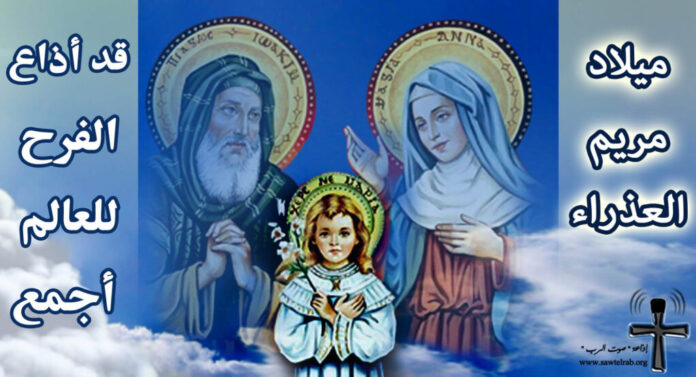
The Feast of the Nativity of the All-Holy Mother of God, and the Dogma of the Immaculate Conception in Catholic and Orthodox Teaching
When we look at the life of the holy Virgin Mary and meditate on her pure life, we must rely on the books of divine revelation and on the extensive studies left to us by the Fathers of the Church in interpreting Holy Scripture. According to the teaching of these Fathers, dozens of prophecies proclaimed by divine revelation and recorded in the prophetic books of the Old Testament were fulfilled in the Virgin Mary, and the Fathers also saw in certain biblical figures and events symbols and signs pointing to her.
She is the woman meant in God’s promise of salvation to humanity: “The seed of the woman shall crush the head of the serpent” (Genesis 3:15), and her seed is Christ Jesus, who was conceived in her by the Holy Spirit and not by the seed of a man. She is the new Eve, just as her Son Christ is the new Adam. And if God took a rib from Adam’s side and made Eve, the first woman, from it, then in the renewal of creation God incarnate, the second Adam, was born of the Virgin, who is the second Eve. She is the Virgin of whom the prophet Isaiah (eighth century BC) spoke in his famous prophecy: “Behold, a virgin shall conceive and bear a son, and shall call his name Immanuel” (Isaiah 7:14), which means “God with us” (Matthew 1:23). The Fathers dealt in their writings with these prophecies, symbols and signs, and included some of them in the books of prayer.
The righteous of old also gave Mary, daughter of David, the holy Virgin, beautiful and radiant names: Ezekiel, son of the exile, called her “a closed gate”; Solomon called her “a garden locked, a fountain sealed”; David called her “a city in which Christ sprang up like grass”, without seed, “and became food for the nations”, and on the day of his birth he set us free from the curse.
“The bush that Moses saw on Mount Sinai prefigures you, O holy Virgin: the bush represents your holy body, its leaves that did not burn symbolize your virginity, and the fire in the bush symbolizes God who dwelt in you.”
“The chariot that the chosen prophet Ezekiel saw cannot match your beauty: the living creatures harnessed to it and the cherubim give blessing, and the images of the four faces, the lion, the ox, the eagle and the man, differ from one another. But your knees, O blessed Mother, became a chariot for him, your arms a wheel, and your mouth sings of glory.”
“Moses prefigured you by the bush (O Mary), your father David by the Ark of the Covenant, Gideon by the fleece, and righteous Jacob by the ladder by which the human race went up to heaven.”
“Blessed are you, O Mary, for the Ark of the Covenant that Moses made as a model mystically prefigures you: it held the two tablets written by God, but you, O Mary, held the true Bread of Life.”
“The rock from which rivers flowed in the wilderness prefigured you, O holy Virgin, for from you the Son of God, who is the rock of truth, as the Apostle Paul says, shone forth to the world. O Virgin full of charm, King David prophesied of you, saying: The king’s daughter stood (at the king’s right hand) in glory and holiness, and the King desired her beauty, came down and dwelt in her womb.”
Some of the Fathers saw other symbols pointing to the Virgin, such as the tree on Mount Moriah that held the ram by which Isaac was saved from sacrifice, Aaron’s rod that blossomed and bore almonds, and others.
The Virgin’s Lineage
The holy Virgin Mary belongs to the tribe of Judah and is of the line of David. She is related to Elizabeth, the mother of John the Baptist, whom the holy Gospel calls the Virgin’s kinswoman (Luke 1:36); it is said she was her aunt. Salome, the wife of Zebedee and mother of James and John, was also related to the Virgin Mary (Matthew 27:56; Mark 15:40). The holy Gospel gives the genealogy of the Lord Christ through Joseph, the Virgin’s betrothed (Matthew 1:16; Luke 3:23; Acts 2:30; Romans 1:3), and the Virgin and Joseph are of the same tribe.
So the Virgin Mary descends from priests, kings and prophets; she is a daughter of David, which is why the angel, announcing to her the divine conception, said: “You will conceive in your womb and bear a son… He will be great, and will be called the Son of the Most High; and the Lord God will give to him the throne of his father David, and he will reign over the house of Jacob for ever” (Luke 1:31-33).
Joachim and Anne, the Barren Parents of the Virgin Mary
Church tradition, based on the teaching of the apostles, tells us that the Virgin Mary’s parents were Joachim and Anne; that Anne’s father was the priest Matthan, of the tribe of Levi and the house of Aaron; and that Anne’s mother was Mary, of the tribe of Judah. Joachim and Anne lived in a village near Nazareth in Galilee; they were well off and divided their income between the Temple and the poor, keeping the rest for their own needs. They were barren, righteous before God and walking according to his divine laws. Among the Jews barrenness was seen as a curse from God and a disgrace before people, because every Jewish girl hoped and prayed that the Christ, the awaited Messiah, would be born of her. So Joachim and Anne persevered in prayer, begging God to remove the disgrace from their home, and they reached old age without their prayer being answered.
It is said that Joachim once came to the Temple of the Lord to present an offering, and the priest refused it because the one offering it was “barren”. Joachim went home grieved, broken-hearted and humiliated, and wept much before God, together with his wife Anne. God answered their prayer and gave them a daughter, whom they named Mary. Some say it is an Aramaic name made of “mor” and “yam”, meaning “sea of bitterness”; others say the name Mary means “star of the sea”, or “light”.
The Immaculate Conception of the Virgin and Her Birth
We must mention here that the conception of the Virgin Mary took place according to the natural law: she was born of a man, Joachim, and a woman, Anne, and the Virgin is the daughter of barren parents, like Isaac, Samuel and John the Baptist.
Here we enter a doctrinal disagreement. The Orthodox Church does not accept the dogma of the Immaculate Conception and says that the Virgin, like these and like all people, inherited from her parents the sin of our first parents, Adam and Eve, called “original sin” or “ancestral sin”, which covers all humanity from Adam onward: when he sinned he represented his descendants, and his offspring shared in the responsibility for that sin, which could only be removed from fallen humanity by the incarnation of the second Person of the Holy Trinity.
That is why the Apostle Paul says: “Sin came into the world through one man and death through sin, and so death spread to all men because all men sinned” (Romans 5:12). And David said: “Behold, I was brought forth in iniquity, and in sin did my mother conceive me” (Psalm 51:5). No one who has put on flesh has been exempt from inheriting this sin except our Lord Jesus Christ, “who took all that is ours except sin”, and who became the expiation for the sins of the world: “they are justified by his grace as a gift, through the redemption which is in Christ Jesus, whom God put forward as an expiation by his blood, to be received by faith. This was to show God’s righteousness, because in his divine forbearance he had passed over former sins” (Romans 3:24-25). And just as sin came into the world through one man, so through one man it was taken away (Romans 5:12, 15). So, in the view of the Orthodox Church, the Virgin, like all people, was born under the rule of sin; she was probably born in Nazareth.
In the teaching of the Catholic Church, on the other hand, which is also entirely acceptable, the Immaculate Conception, or “Our Lady conceived without stain”, is a Christian dogma concerning the Virgin Mary that belongs to Mariology. Although it is found in many writings of the Fathers, it was officially defined during the pontificate of Pope Pius IX in 1854. It states that the Virgin Mary was conceived without inheriting original sin, that is, the sin of Adam and Eve inherited by the human race; not by her own power, but, as the wording of the dogma says, “in view of the merits of Jesus Christ”. In other words, Jesus saved her too, like all Christians, but in a unique way, before his preaching and crucifixion, from the very first moment she was conceived in her mother’s womb. The dogma does not say that her conception took place without sexual union; it says that Mary was preserved from original sin from the first moment of her conception. The aim of the dogma is to make clear that the Virgin had no connection with sin at all: she is completely pure, with no original or personal sin, from the first moment of her conception and throughout her human existence, because of the place Mary was to have as Mother of God.
Catholic theology explains Pius IX’s definition as follows:
“The Immaculate Conception, freedom from original sin, was a gift of God to Mary and an exceptional dispensation given to her alone. From this we see the efficient cause of Mary’s immaculate conception, which is Almighty God, and its meritorious cause, which is Jesus Christ the Redeemer. It follows that Mary needed redemption and was in fact redeemed: by her natural origin she, like all the children of Adam, was subject to the necessity of contracting original sin, but by a special intervention of God she was preserved from the stain of original sin. So she was redeemed by the grace of Christ, but in a more perfect way than all other human beings. The proximate final cause of Mary’s immaculate conception is her divine motherhood.”
The Catholic Church also sees several passages of Scripture that support the dogma, such as the Song of Songs 4:7: “You are all fair, my love; there is no flaw in you.” Christians believe this verse applies to Mary and to her being “without flaw”, and original sin is one of those flaws.
Likewise she is called “full of grace” in Luke 1:28, and being full of grace also means being free from original sin. Besides, some translations have “favoured one”, which leads us to ask when this favour and fullness of grace began; it must extend over the Virgin’s whole life, from the very first moment.
A number of other passages rely on the Book of Sirach and other books of the Old Testament, as well as on the writings of the early Fathers of the Church.
As we have said, the Orthodox Churches object to the dogma of the Immaculate Conception and see it as contrary to the teaching of Scripture. The objection comes mainly from Mary’s words in the Gospel of Luke: “My spirit rejoices in God my Saviour” (Luke 1:47). But Catholic theologians see no contradiction in this verse, since the saving act was accomplished by Jesus her Son, whether before or after the crucifixion; especially since the Book of Psalms says, “the Most High has sanctified his dwelling” (Psalm 45:5 in the Septuagint; Psalm 46:4): how could the Son take as his dwelling a body bearing original sin? The second objection comes from the Letter to the Romans, which speaks of original sin as universal to all people; but Catholic theologians also note that the Letter to the Hebrews says it is appointed for all people to die once (Hebrews 9:27), and yet the Old and New Testaments name several people who came back to life through special miracles, and so died twice, not once: an exception is always possible.
The Eastern Orthodox Churches rejected the dogma, considering that it did not belong to the substance of the faith and that no special dogmatic definition was needed, in keeping with these Churches’ view of original sin. As for Martin Luther, he is said to have accepted the Immaculate Conception, citing Saint Augustine as his proof, but most Protestants regard the dogma as a matter of theological quarrelling.
However, the Catholic Church makes clear and affirms that although the Virgin was preserved from original sin, she was not exempt from its consequences, namely pain and suffering.
“He who is mighty has done great things for me, and holy is his name” (Luke 1:49).
The life of the Virgin Mary is the best commentary on this verse, and the life of the Mother of God is the best example for us human beings.
A human being like us, sanctified by grace, gave birth to God. What a great mystery, beyond all understanding! A virgin becomes the Mother of God! In this one expression lies “the whole mystery of the economy of salvation” (Saint John of Damascus).
The Virgin Mary’s humility drew God to her; that is the heart of the matter. “Blessed are the pure in heart, for they shall see God” (Matthew 5:8). She not only saw God; she carried him in her womb. And so through her journey the words of the prophets about the salvation God promised humanity are fulfilled. God becomes man.
The Church celebrates the Nativity of our Lady because in her God’s plan for the salvation of humanity was fulfilled. From her birth we learn that “every human being born is a project of holiness and a bearer of God”, if they so choose, of course. The Church also celebrates several feasts of the Mother of God during the year.
But we must clearly understand that all the major feasts of the Church (twelve of them, not counting Easter), fixed and movable, are feasts of the Lord, because they centre on the Lord Jesus Christ and are connected with him. They are called “feasts of the Lord” from the word “Lord”, not “Lady”. Even the Nativity of the Mother of God, her Entry into the Temple, the Annunciation and the Dormition, which are among the twelve feasts, are feasts of the Lord connected with him, even though they are called feasts of the Mother of God.
It is worth noting that the Feast of the Nativity of the Mother of God (8 September) is the first great feast in the Byzantine Church, since the liturgical year begins on 1 September; likewise, the Feast of the Dormition of the Mother of God is the last great feast, on 15 August.
Why did the Church choose to celebrate this feast on precisely the eighth day of the church year?
The answer has to do with what this day represents: it is the day that comes after the six days of creation and the Sabbath. If the seventh day is the day of the Old Covenant, the eighth day is the day of the New Covenant.
God created the world in six days and rested on the seventh. The eighth day comes as the day of the last things, the day of the Kingdom, which the Lord Jesus inaugurated by rising from the dead. Through the resurrection this day became both the first and the eighth day, and it remains open to us for ever; we begin it here and now.
That is why the Church tells us on this feast: “Today humanity is born as a new creation, after falling long ago through sin, and begins its cycle to pass through the sea of the year to the glorious Resurrection.” And whoever believes in our God’s salvation does not die at the end of their years but falls asleep like the Mother of God, and God takes them to himself for eternal life.
From the very nature at which humanity’s enemy shot his arrows to destroy it came the one who trampled on the serpent’s head and opened the gates of heaven to humanity.
By this, too, the Church wanted to say that the Mother of God, who carried in her womb the Ruler of all, carries in her womb the whole cycle of our liturgical feasts, from beginning to end.
How could it be otherwise, since she is the mother who holds us close: whenever we look at her icon, she looks us in the face to say: “Let us rejoice together in the Lord Jesus Christ; he is the only Saviour. My God and your God, my Saviour and your Saviour.” With Mary’s birth the first tidings of joy and the fulfilment of the promise of salvation begin. This little girl will be the Mother of God. She overcame all kinds of trials through her passionate love for God and her closeness to him. We are therefore called to follow in her footsteps and take her as our model: whoever is united with God and his grace overcomes every kind of sin.
Sin is never stronger than a human being, however great and heavy it may be; it is overcome by the light of Christ. This reminds us of what God said to Cain at the very beginning of Genesis: “Sin is couching at the door; its desire is for you, but you must master it” (Genesis 4:7). These words, “you must master it”, are for each of us: we master sin by standing firm in God.
With Mary’s birth our journey back to the Kingdom begins. And with her falling asleep and passing into heaven, what the Lord Jesus told us is fulfilled: “He who believes in me, though he die, yet shall he live” (John 11:25). We were created to be people of the resurrection, in the Risen One, for ever and always.
The History of the Feast
The origin of the feast goes back to the middle of the fifth century in Jerusalem, when a church was dedicated to Mary the Mother of God near the “Sheep Pool”, or Pool of Bethesda, in Jerusalem.
From Jerusalem the celebration of the Virgin’s Nativity passed in the sixth century to Constantinople, where Saint Romanos the Melodist composed hymns for this feast, some of which we still pray in our services.
From the East the feast passed to the West under Pope Sergius I (687-701), who was of Antiochene origin.
As we have said, the New Testament says nothing about Mary’s childhood, nor about her birth or her falling asleep, because the aim of the Gospels is to proclaim the Lord Jesus, God incarnate, and the plan of salvation through his works and teachings. But Church tradition, which has kept a special place for the Mother of God, says that her birth took place through direct divine intervention, as happened with several people in the Old Testament: Isaac son of Abraham, Samson, Samuel and John the Baptist. All this is part of the mystery of the plan of salvation.
One of the main sources is the “Protoevangelium of James”. We should point out here that not all apocryphal gospels are heretical and corrupt: some are useful, but the Church did not include them in the Bible because they are not directly connected with salvation; others are false and aim to harm the Church, like the Gospel of Judas. The holy Fathers, who confirmed the Church’s teaching, explained all these things, and nothing is hidden from anyone: all of it has been written down since the first centuries of Christianity.
Here is what the “Protoevangelium of James” says: Joachim, Mary’s father, of the tribe of Judah and the line of David, grew up in a devout family that kept the Law and offered sacrifices. He was very rich and presented offerings to God, saying in his heart: “Let my goods be for the whole people, for the forgiveness of my sins before God, that the Lord may have mercy on me.”
Likewise Anne, the mother of the Virgin Mary, was the daughter of the priest Matthan, of the tribe of Aaron, but she was sad because of her barrenness, for among the Jews barrenness was counted a disgrace and a curse from God, while childbearing meant securing descendants for the coming of the awaited Messiah.
Anne prayed to the Lord, saying: “O God of my fathers, bless me and hear my prayer, as you blessed the womb of Sarah and gave her a son, Isaac.” And behold, an angel of the Lord said to her: “Anne, God has heard your prayer; you will conceive and give birth, and your offspring will be spoken of throughout the whole world.” Anne answered: “As the Lord my God lives, whether I give birth to a boy or a girl, I will offer it to the Lord, and it will dedicate its life to the service of God.” Anne conceived, and in the ninth month she gave birth to a daughter and named her “Mary”, and she gave thanks to God, saying: “My soul is magnified this hour.”
The Liturgy of the Feast
The hymns of the feast are full of joy, gladness and delight: “This is the day of the Lord; rejoice, O peoples…”; “Today the tidings of joy have appeared to the whole world…”; “Today is the beginning of our salvation, O peoples…”; “…let the earth adorn itself with its finest ornaments, let kings dance for joy, let priests rejoice in blessings, and let the whole world keep festival…”.
The readings of the feast are very important, because they link the Old and New Testaments:
- First reading: the ladder set up (Genesis 28:12-14). “And he dreamed that there was a ladder set up on the earth, and the top of it reached to heaven; and behold, the angels of God were ascending and descending on it! And behold, the Lord stood above it and said, ‘I am the Lord, the God of Abraham your father and the God of Isaac…'”
The Virgin Mary is the ladder by which God came down. - Second reading: the closed gate of the sanctuary (Ezekiel 44:1-2). “And the Lord said to me, ‘This gate shall remain shut; it shall not be opened, and no one shall enter by it; for the Lord, the God of Israel, has entered by it; therefore it shall remain shut.'”
According to the Church’s interpretation, this reading points to Mary’s perpetual virginity (before, during and after giving birth) and her miraculous motherhood, beyond all description. - Third reading: Wisdom and her house (Proverbs 9:1). “Wisdom has built her house, she has set up her seven pillars. She has slaughtered her beasts, she has mixed her wine, she has also set her table. She has sent out her maids to call from the highest places in the town…”
According to the interpretation of the Church and its holy Fathers, this text points to the Virgin Mary as the house that God, the supreme Wisdom, built, and to the invitation of humanity to the Lord’s table.
The Theology of the Feast
One of the hymns of Matins says: “O astonishing wonder! The fruit that came forth from the barren one, at the command of the Creator and Ruler of all, has mightily put an end to the world’s barrenness in good things.”
Just as Joachim and Anne are an image of the barren world, so Mary is an image of the new, fruitful world, an image of the Church that never grows old.
Our joy at the birth of the Virgin Mary is gladness and joy in the Lord Jesus who will be born of her: Christ, who made Mary the Mother of life by the Holy Spirit and made her the Mother of light, also makes the Church a fountain of life.
This is something we often forget: we treat the Mother of God as if she stood on her own, apart from God’s role in her life. But the Church calls Mary “Mother of God” in all its hymns and songs, and so she always appears in icons with the Lord Jesus, except in very special cases.
Finally, the Church’s celebration of the birth of Mary, Mother of God, is the proclamation of joy at the birth of the dawn of salvation, because she who was born of barren parents loved God and consecrated herself to him, and accepted to obey his plan of salvation and give birth to Christ for the world.
Fr. Gerard Abi Saab