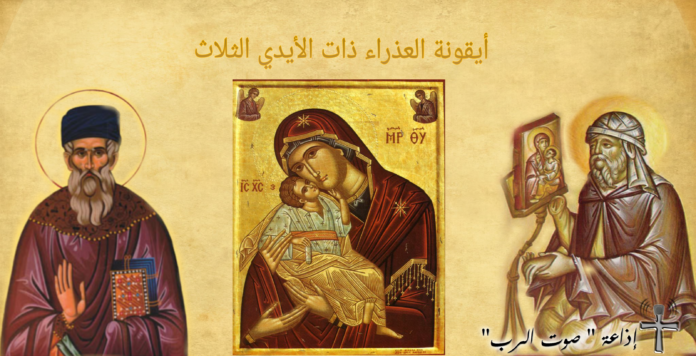
The Icon of the Three-Handed Virgin (Tricheirousa)
This icon is connected with the life of Saint John of Damascus. It goes back to the eighth century, when Emperor Leo came to power in Constantinople and waged war on the holy icons: he ordered them removed from the churches and began to persecute the Orthodox faithful who gave them the veneration due to them.
Saint John, who was in Damascus, capital of the Umayyad state, heard of this violent campaign against the Church. At that time he was a layman serving as minister of the treasury to the Umayyads, and his name was Mansur ibn Sarjun. He rose up to answer everyone who attacked the holy icons, calling them heretics and saying they were fighting against the incarnation of the Son of God from the Virgin and the deification of humanity by divine grace. He relied greatly on the words of Saint Basil the Great: “The honour given to the image passes to its prototype.”
When the news reached the icon-hating emperor, he wanted revenge on Saint John and resorted to trickery and deceit. He called in some scribes to imitate the saint’s handwriting in a forged letter, as if the saint had written it to Emperor Leo, saying he was ready to work with him against the Umayyad caliph and hand over the city of Damascus to him. Then Emperor Leo sent the forged letter to the Umayyad caliph, along with another letter exposing Mansur’s supposed deceit and betrayal.
When the caliph received these two letters, he quickly summoned Mansur (John) and showed him the forged letter, saying: “Do you know this handwriting, Mansur, and who wrote it?” The saint answered: “O prince, the handwriting looks like mine, but it is not mine; my lips never spoke these words, and I have never seen this letter until this very hour.” The caliph did not believe him and ordered his right hand to be cut off. The sentence was carried out at once, and his hand was hung up in the middle of Damascus.
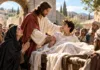
In the evening John sent to the caliph asking him to give him back his severed hand, and the caliph allowed him to take it. Saint John took his severed hand, went home and climbed to his upper room (his place of prayer), where this icon was. He placed his hand against the icon and threw himself down before it, praying with reverence and tears that God would reveal his innocence of this charge and heal his hand as proof of it, and he begged the intercession of the Virgin Mary, until he grew tired and fell asleep. Then the Virgin Mary appeared to him in a dream and said: “Your hand is healed; it will be the pen of a swift writer.” She took the hand from the icon and put it back in its place, and it became as it had been. The saint woke up with his hand healed and began to pray, giving thanks to God and to his all-holy Mother. As a witness to the amputation, the place where it had been cut remained marked like a red thread.
It is said that when he woke he at once sang the hymn “In you, O full of grace, all creation rejoices”. In the morning the news of this wonderful healing spread through all of Damascus and reached the caliph. Informers came and told him that John’s hand had not been cut off, but that he had paid one of his slaves a great deal of money to have his hand cut off instead. The caliph summoned the saint to hear his defence, and the saint showed him the mark of the cut, which remained like a red thread. The caliph was astonished and asked in amazement which doctor had restored his hand. John told him about the miracle that had happened to him. Then the caliph realized the deception and that he had condemned the saint unjustly; he asked his forgiveness and restored him to his former dignity as minister. But the saint, who had vowed to leave worldly life and devote himself to the angelic life, asked the caliph’s permission to leave everything and give himself to his Lord. The caliph was sad to lose John as a friend and minister, but in the end he let him go.
The saint went home, sold his possessions, gave the money to the poor and set out for Palestine, where he took refuge in the holy monastery of Saint Sabbas, taking nothing with him but this holy icon. He had a silver hand made and attached it to the icon in thanksgiving for his miraculous healing and in memory of it.
The icon remained in the monastery of Saint Sabbas from the middle of the eighth century until the thirteenth century, when Saint Sava, archbishop of Serbia, visited the monastery; the holy icon was given to him as a blessing, and he took it with him to Serbia.
When the Turks invaded Serbia, the Orthodox took this icon, tied it on a donkey and let it go wherever it wished, with no one to lead or guide it, trusting that God would take care of the icon and bring it to a safe place. And so it happened: the donkey reached Mount Athos and stopped at the gate of the monastery of Hilandar. The monks joyfully received this gift from the Mother of God and carried it into the sanctuary of the main church.
At the beginning of the seventeenth century the abbot of the monastery died, and the monks gathered to elect his successor. They disagreed among themselves, and there was turmoil and division. One day during Matins they saw the icon on the abbot’s throne in the middle of the church. They put it back in the sanctuary, thinking the church servers had moved it. But this happened several times, until the Virgin Mary appeared to a hermit and said to him: “From now on I will be the abbess of the monastery, so that there will be no more division and quarrelling among you over electing a new abbot.”
From that time until today the icon has remained in the abbot’s place in the middle of the church. No abbot is elected for this monastery; it is governed and run by a hieromonk who serves as vicar.
Fr. Gerard Abi Saab