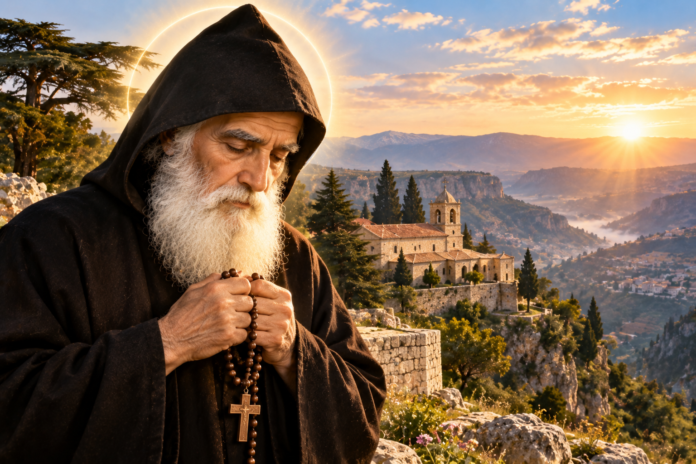
The Life of Saint Charbel and the Stages of His Canonization
Saint Charbel Makhlouf, also known as Mar Charbel, was a Lebanese Maronite monk, priest, and hermit. Born Youssef Antoun Makhlouf in Bekaa Kafra, Lebanon, in 1828, he lived a life of monastic prayer and asceticism before choosing the eremitical life at the Hermitage of Saints Peter and Paul in Annaya, where he spent the final years of his life. He died on Christmas Eve in 1898, and the Church canonized him in 1977.
What follows is the story of Saint Charbel’s life, from his birth and entry into the Lebanese Maronite Order, through his years at the Monastery of Saint Maron and the hermitage in Annaya, to his death, the stages of his beatification and canonization, and the worldwide spread of devotion to him and accounts of miracles attributed to his intercession.
Saint Charbel’s Birth and Early Life
Youssef Antoun Makhlouf was born on May 8, 1828, in Bekaa Kafra, North Lebanon, to Maronite parents, Antoun Zaarour Makhlouf and Brigitta Chidiac. He had two brothers, Hanna and Bechara, and two sisters, Kawn and Warda. Youssef received a Christian upbringing that nurtured in him a deep love of prayer from childhood.
He was drawn to monastic and eremitical life, following the example of his two maternal uncles, who were hermits at the Monastery of Saint Anthony of Qozhaya. From them, he inherited, as it were, the torch of heroic virtue.
His father died on August 8, 1831, in Ghirfine, a village near Amchit, while returning home after having been subjected to forced labour by the Turkish army. Youssef was therefore raised by his mother as an orphan. She later married Lahoud Ibrahim, who became the parish priest under the name Abdel Ahad.
Youssef learned the basics of Arabic and Syriac at the village school. He was so devout that the people of his village called him “the saint.”
Every day, he led his small flock to pasture, then went to a cave where he knelt before an image of the Virgin Mary and prayed. The cave thus became his oratory and his first hermitage, and later became a place of prayer and pilgrimage for the faithful.
Saint Charbel Enters the Lebanese Maronite Order
One morning in 1851, Youssef left his family and village and went to the Monastery of Our Lady of Mayfouq to become a monk, where he spent the first year of his novitiate.
He was then transferred to the Monastery of Saint Maron in Annaya, where he entered the Lebanese Maronite Order and took the name Charbel, after a second-century martyr of the Church of Antioch.
On November 1, 1853, he made his religious vows in the same monastery, fully aware of their demands: obedience, chastity, and poverty.
He completed his theological studies at the Monastery of Saints Cyprian and Justina in Kfifane, Batroun, under the guidance of Saint Nimatullah Kassab Al-Hardini, who was a model for the monks and a living image of the great monastic saints, both in his private and public life.
On July 23, 1859, Brother Charbel Makhlouf was ordained a priest at Bkerké through the laying on of hands by Bishop Youssef Al-Marid, the Maronite Patriarchal Vicar.
Saint Charbel’s Life at the Monastery of Saint Maron in Annaya and at the Hermitage
Father Charbel lived at the Monastery of Saint Maron in Annaya for sixteen years. He was obedient to his superiors and faithfully observed the monastic rule. He was also rigorous with himself in asceticism and mortification. He detached himself from everything worldly in order to devote himself entirely to the service of his Lord and the salvation of his soul.
At the beginning of 1875, God inspired Father Charbel to withdraw to the Hermitage of Saints Peter and Paul, which belonged to the Monastery of Saint Maron in Annaya, although superiors did not usually grant permission for the eremitical life easily.
While the superior was still hesitant, he received what was regarded as a sign from heaven: the miracle of the lamp.
One evening, Father Charbel asked the servant to fill his lamp with oil, but the servant filled it with water instead. Yet the lamp lit and burned normally. This sign was regarded as one of the first miracles associated with Saint Charbel and hastened the day when the hermit would be allowed to enter the solitude he so deeply desired.
On February 15, 1875, Father Charbel moved permanently to the hermitage, where he became a model of holiness and asceticism. He spent his time in silence, prayer, adoration, and manual labour in the fields, and left the hermitage only at the command of his superior.
There he followed the way of the holy hermit Fathers, kneeling on a reed mat before the Blessed Sacrament, communing with the Lord and remaining absorbed in His presence throughout the night.
He spent twenty-three years in the hermitage, wholly devoted to the service of his Lord and faithfully observing the rule of the hermits.
The Death of Saint Charbel
On December 16, 1898, while celebrating Mass, Father Charbel suffered a stroke and entered an agony that lasted eight days. He endured the pains of dying with calm and serenity, despite intense suffering.
Throughout his agony, Father Charbel continued to repeat the prayer he had been unable to finish during Mass:
“Father of Truth, behold Your Son, a sacrifice pleasing to You!…”
He also repeated the names of Jesus, Mary, Saint Joseph, and Saints Peter and Paul, the patrons of the hermitage.
On December 24, 1898, Christmas Eve, Charbel’s soul returned freely to the house of the Father, like a drop of dew returning to the vast ocean.
He was buried in the cemetery of the Monastery of Saint Maron in Annaya.
The Wondrous Light that Shone over Saint Charbel’s Tomb
After his death, extraordinary lights were seen above his tomb.
These phenomena led to the transfer of his body, which, according to accounts from the time, showed signs of perspiration and blood. With the permission of the Maronite Patriarchate, his body was placed in a special coffin and moved to a new tomb inside the monastery.
From that time onward, crowds of pilgrims began to come seeking his intercession, and many healings and spiritual graces were attributed to it.
In 1925, the cause for his beatification and canonization was presented to Pope Pius XI by Abbot General Ignatius Dagher Al-Tannouri and his Procurator General, Father Martinos Tarabay. The cause was accepted in 1927, together with those of Father Nimatullah Kassab Al-Hardini and Sister Rafqa Al-Rayess.
In 1950, Father Charbel’s tomb was opened in the presence of an official commission and physicians. They examined the body, prepared a medical report, and placed it in a special container within the coffin.
Accounts of healings then multiplied in a remarkable way, and tens of thousands of pilgrims from different denominations and communities flocked to the Monastery of Annaya to seek the saint’s intercession.
Saint Charbel’s Miracles and Their Spread throughout the World
The fame of Mar Charbel’s miracles spread far beyond the borders of Lebanon. The letters, testimonies, and reports preserved in the records of the Monastery of Saint Maron in Annaya bear witness to the worldwide spread of his reputation for holiness.
This remarkable phenomenon led many people to return to faith, prayer, and a more fervent Christian life.
Mar Charbel’s tomb became a place of pilgrimage drawing people of every social background and age. Before it, all stand equally in reverence and supplication, without distinction of religion, denomination, or community.
The healings recorded in the registers of the Monastery of Saint Maron in Annaya and attributed to the intercession of Saint Charbel number in the tens of thousands, not including those reported throughout the world among people of different religions and denominations that were never entered into the monastery’s records.
Some of these healings involved people who had not been baptized.
According to the testimonies collected, graces attributed to his intercession were received in different ways: through prayer and requests for intercession, through oil and incense, through leaves from the oak trees near the hermitage, through soil taken from near his tomb, through visiting his shrine and touching the door of his tomb, or through his image or statue.
Some of these healings were physical, but the most important are the healings of the soul.
How many penitents have returned to their Lord through the intercession of Mar Charbel after crossing the threshold of the Monastery of Saint Maron in Annaya or the Hermitage of Saints Peter and Paul!
The Beatification and Canonization of Saint Charbel
In 1954, Pope Pius XII signed the decree introducing the cause for the beatification of the hermit Charbel Makhlouf.
On December 5, 1965, Pope Paul VI proclaimed Father Charbel blessed at the close of the Second Vatican Council.
In 1975, Pope Paul VI signed the decree recognizing the miracle required for the canonization of Blessed Charbel.
On October 9, 1977, at the Vatican, Pope Paul VI solemnly canonized Saint Charbel Makhlouf, officially enrolling the Lebanese hermit among the saints of the Church.
Among the many miracles attributed to the intercession of the man of God, the Church selected two for his beatification and a third for his canonization:
- the healing of Sister Marie-Abel Kamari, of the Sisters of the Sacred Hearts;
- the healing of Iskandar Naim Obeid, of Baabdat;
- the healing of Mariam Awwad, of Hammana.