Meditation for the Second Sunday of Lent (Sunday of the Holy Relics and memory of Saint Gregory Palamas) – Mark 2:1-12
The Melkite Greek Catholic Church honours the relics of the saints. The feast of the Holy Relics was established by Patriarch Maximos III Mazloum, of blessed memory, in his patriarchal letter of 1 December 1843; he also organized its celebration and gathered and composed the pieces sung in its proper Divine Office. The feast of the Holy Relics thus complements the feast of the veneration of the holy icons.
Before that, in the second half of the fourteenth century, the Church of Constantinople began to celebrate on this Sunday the memory of our father among the saints Gregory Palamas, Archbishop of Thessalonica. This tradition then gradually spread to all the Byzantine Churches.
At its synod in 1971, the Melkite Greek Catholic Church adopted the feast of Saint Gregory Palamas on this Sunday.
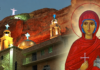
The life of Saint Gregory Palamas, Archbishop of Thessalonica: he was born around 1296 in Constantinople, into a wealthy family with many children. His father died when he was young, and his mother took care to give her children a good Christian upbringing. The devout young man acquired a broad religious and literary education in the finest schools. Around the age of twenty, drawn to the ascetic life, he went to the Holy Mountain (Athos) and became the disciple of the most learned and holy elders. He then persuaded his mother and siblings to follow the path of detachment and true worship; they distributed their wealth to the poor and all entered monasteries. But the errors spreading in his time, particularly concerning hesychast prayer and the uncreated light, brought him back to defend the true faith. He was ordained priest and then bishop, and he fought with rare courage, refuting the heretics’ empty talk and protecting his flock from their tares. He fell asleep in the Lord at about sixty-three, in 1359, leaving the memory of a mystic monk and a good and faithful shepherd. Gregory Palamas, theologian of the Church, came to know in the light the source of his light; his faith in God led him to the One whose radiance never sets, and he glorified him in turn.
As we said, on this fifth Sunday before glorious Easter we honour the holy relics. The saints glorified God in their bodies, which were sanctified by the holy mysteries and by works of repentance, asceticism, mortification, fasting, prayer, vigils and night watches. They are an example for us on the journey of the holy Fast and deserve our veneration. That is why this feast is held and the holy relics are carried in procession on this Sunday.
Relics of the saints are placed in altars when new churches are consecrated, and normally the Divine Liturgy may only be celebrated on an altar containing relics of saints. Our liturgical prayers remind us of the holy relics on the feasts of wonderworking saints whose relics are kept in the churches of the great Christian cities.
On the first Sunday of Lent we honoured the holy icons. On this second Sunday we honour the holy relics. And on the coming third Sunday we will honour the holy relic that surpasses all others, the wood of the precious Cross. We hold processions on these Sundays
so that they may accompany us on our fasting journey toward Holy Week and the joys of the glorious Resurrection.
Today’s Gospel tells us about some people who brought a paralysed man to Jesus, asking him, naturally, to free him and heal him of his physical disability. But Jesus turned in a strange way to this paralysed man, though paralysis is the most visible of illnesses, as if he saw only the sickness he cared to heal, and said to him, “Your sins are forgiven.” And those present were astonished.
These events leave us with many questions. What is Jesus’ understanding of sin that made him overlook the physical need and focus on the spiritual illness? And second, why did the Church choose this text for us on the Sunday of Saint Gregory Palamas, whom we honour today, the man who in the fourteenth century stood up to the rationalism of Barlaam of Calabria?
The conflict between Palamas and Barlaam was not theoretical or an intellectual debate; it was a disagreement about how a person relates to God, worships him, lives with him and journeys toward him.
Yes, perhaps modern atheism is not disbelief in God’s existence, which was the form of atheism of the past, but the falsification and corruption of that faith. That is why the danger to faith no longer comes from outward persecution but from losing the purity of faith, that is, from within. If we look at our understanding of sin, one of the most delicate matters in our relationship with God, we find that this delicate understanding is truly threatened, and perhaps falsified, by Barlaamite Western rationalism. So let us see what sin is in our true Christian understanding!
Rationally, people today ask why religious language calls certain acts and behaviours “sin,” when many times they seem useful to me personally, convenient or comfortable, and satisfy my desires without harming anyone else, and perhaps sometimes even seem useful to others. Why this “outdated” and “complicated” notion of sin?
Rationally, most people today analyse the notion of sin and collide with the old “religious” ideas about it! So they want to get past every barrier and every moral restraint, even if it sometimes costs them silencing the voice of conscience within, putting up with all the inner confusion this way of analysing leaves behind. Then they resort to new names for those behaviours to justify them. If we took the most delicate and important human behaviours and asked how modern people define sin in them, we would find that we often corrupt it: substituting cleverness for bribery, for instance, sometimes confusing love with adultery, turning service into exploitation, replacing charity with self-interest, defining happiness as comfort… and we are quick to analyse all this rationally to justify it.
Let’s think rationally, like people today, “with modern concepts,” as they say! Does a bribe do harm if it gets everyone’s business moving? What is the harm in adultery, say, if it satisfies the desire of both parties? What is wrong with exploitation if it keeps everyone in balance? Is it shameful to look after our own interests? And why sacrifice and love and all these angelic Gospel burdens when we are only human? Isn’t rest found in relaxing? Does this hurt anyone? And so much more… Where is the sin in all these things?
Religiously, and how many dangers this word carries and how many misunderstandings it bears!, we also err in interpreting sin by defining it as a transgression of God’s commandment, as if God were the injured party who, for the sake of his justice, perhaps his “selfishness” and his honour, must recover his rights from us by imposing punishments in this life before hell to come. But if we thought more deeply, we would realize that sin cannot touch God. If God has given us laws and rules forbidding sin, he does not do it for any interest of his own, but for us, “that it may go well with us… and that we may live.” The God of the Bible, our God, is not the god of the Epicureans or the god of Aristotle who does not care about humanity or the world!
The truth about sin, from a practical Christian point of view and as Saint Gregory Palamas defines it, is rejecting God as Father, rejecting fatherly love, that is, rejecting divine grace and living in rational isolation. What grieved the father in the parable of the “prodigal son” was his son’s departure. The son insulted his father by depriving him of his presence as a son; that is why this sin is forgiven only by returning. Outpoured divine love has made God, if one may say so, “vulnerable.” Sin is rejecting the light and loving darkness when the light comes to us. The son’s sin always lies in thinking only by himself. The greatest insult to the father is to ignore his love. We can live rationally and determine our destiny by our own analyses. Or we can live with God by faith, and only then do we give the Father his due. In essence Adam sinned in nothing except wanting to live, think and plan for himself without God. Isolating ourselves from God also means isolating him. Isn’t this the true atheism, and therefore the sin between the son and his father, between us and God? “Sin” is claiming to be sons while the Father’s love is not in us. Life with God doesn’t just mean acknowledging his existence or knowing many things about him; life with God means being happy in our life with him, in other words, that God be our happiness. Reading theology, for example, only for the sake of knowledge is a sin! Because if we read theology and do not rejoice, become reverent and live, we insult God, who came to us as life. God did not come to occupy our minds but to set our hearts on fire. Life with God is not information but experience. God is not grasped or described by studies; he is spoken of from experience. Studies are positive when they deepen experience. Barlaam represents the deception of religion as knowledge, and Saint Gregory Palamas reminds us of the experience of religion as life.
From the Orthodox point of view, a person lives only on heavenly manna, that is, on divine grace. Man does not live by bread, but by grace and the divine word that comes from the mouth of God. On this basis we define sin as a “loss”: we refuse the grace given to us and live within the limits of a mind cut off from God and his grace. Sin is saying “no” to the divine love pouring toward us and into us.
Do you believe? This is the adventure of faith, indeed its very certainty: we set sail and travel relying on the wind of grace rather than the rowing of our own hands. Every faith has its dimensions; rationalism has its limits, which do not go beyond bodily, human and earthly frameworks. But the dimensions of faith are something else, because they open onto divine, deifying grace and lead us by the Spirit to the paradise of the saints.
Every faith has a path and a goal, and harming them is sin. Saint Seraphim of Sarov defines the Christian’s goal as “acquiring the Holy Spirit,” so whatever hinders this journey is sin. It is on this scale that we must weigh bribery, self-interest and all other desires… and not on the rational scales of the children of this age. This is our great sin, as today’s Epistle says: if those who neglected a message delivered by angels were condemned, “how shall we escape if we neglect such a great salvation?” (Hebrews 2:2-3), refusing to seek grace?
From this view of sin we understand why Christ wanted to forgive that paralysed man his sin before healing his limbs. From a purely rational point of view we can rightly ask what the reasons for fasting are, since it torments the body, or why prayer, which may seem foolish! But if we are seeking divine grace, the question is turned around and becomes: why don’t we fast, pray and keep vigil…?
This is Saint Gregory Palamas’s cry today: to challenge rationalism by seeking grace through fasting, vigils and prayers, rising above the world of earthly logic. “The righteous shall live by faith,” so that, receiving divine grace in purity, we may understand and be worthy of Christ’s words:
“My son, your sins are forgiven; see, you are well; sin no more.”
My brothers and sisters, those who carry the paralysed man are the saints who carry us in their prayer and protect us by their presence in their holy relics, to present us to Christ so that he may heal us.
And we too are living relics in the Church, carrying one another in prayer and fasting, presenting one another to Christ and asking him for salvation, the forgiveness of our sins and healing from the paralysis of our souls and bodies.
This paralysed man is the most important lesson: he did not give in to his paralysis, he did not consider sin and sickness an inevitable fate, and he did not let despair take hold of his heart. This paralysed man accepted the forgiveness Christ offered and received healing as a great gift from God. He is an example of patience in suffering and of hope; he is an example of faith.
I say to my beloved parish: salvation is in Christ; what matters is that you pray to him and hear him say to you, “Your sins are forgiven. Get up! Rise!” Amen.
Note: Saint Gregory Palamas’s date and place of birth (around 1296, in Constantinople), the date of his death (1359) and the subject of the controversy (hesychasm and the uncreated light) have been corrected from the Arabic text.