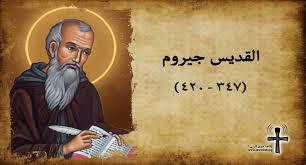
Saint Jerome, also known as Hieronymus (347–420)
Feast: September 30
His Life
Saint Jerome was born around the year 347 in Stridon, on the borders of Dalmatia, Pannonia, and Italy, into a wealthy and devout Roman family.
When he was twelve years old, his father sent him to Rome, where he excelled in eloquence and rhetoric and developed a great passion for the classical Greek and Latin poets. He also took care to copy many books, laying the foundation of a personal library.
Carried away by the attractions of that world, Jerome drifted away for a time from a life of piety and struggled inwardly against his passions. He later repented and received baptism.
He is considered one of the greatest Fathers of the Western Church, especially because of his work on Holy Scripture. He left behind a vast legacy of biblical commentaries, ascetical writings, works against heresies, and numerous letters.
Together with his friend Bonosus, he travelled to Trier to devote himself to prayer. There he began to study theology more deeply through the study of Sacred Scripture.
He later returned to his homeland and spent several years in Aquileia, where his friendship with Rufinus, whom he had already met in Rome, grew stronger.
His relatives turned against him because he encouraged his sister to embrace consecrated virginity. He therefore left for the East, travelling through Greece and Asia Minor before settling in Antioch in 374.
There he was welcomed by Evagrius, who had a profound influence on him and drew his heart more deeply toward the East and the ascetic life.
Jerome also came to know Apollinaris, Bishop of Laodicea, whom he would later oppose when Apollinaris departed from the faith.
Jerome then devoted himself more completely to the study of Scripture and the ascetic life. He withdrew for about four years to the desert of Chalcis, southeast of Antioch, where he learned Hebrew.
In the desert, he endured many bodily hardships. In a letter to Saint Eustochium, he described his struggle with striking frankness:
“The scorching heat of the sun was so fierce that it frightened even the monks who lived there, and yet I imagined myself amid the pleasures and crowds of Rome… In this exile, this prison I had chosen for myself out of fear of hell, with only scorpions and wild beasts for company, I imagined myself among the dancing girls of Rome.
My face was pale from voluntary fasting, and my soul struggled fiercely against lust. My cold body, completely dried up, seemed dead before it had died, and yet passion still lived within it.
So I threw myself in spirit at the feet of Jesus, washing them with my tears, and subdued my body with fasts lasting entire weeks. I was not ashamed to confess the temptations that came upon me… I did not cease beating my breast day and night until peace returned to me.”
Jerome returned to Antioch around the year 377. His gifts had become evident, and Bishop Paulinus urged him to accept ordination to the priesthood.
Jerome agreed on the condition that he would not be permanently attached to any particular church, so that he could devote himself to the Word of God wherever the Lord might call him.
Having heard of Saint Gregory of Nazianzus, Jerome left Antioch and went to join him in Constantinople. He remained close to him for about two years, until the Ecumenical Council of Constantinople in 381.
The following year, Jerome accompanied Paulinus of Antioch and Saint Epiphanius, Bishop of Salamis in Cyprus, to Rome.
Pope Damasus took him as his secretary and entrusted him with the work of revising and translating the Bible into Latin.
Jerome combined his scholarly work with an intense ascetic and spiritual life. Many people gathered around him, including holy women from noble Roman families: Paula and her daughters Blesilla and Eustochium, Marcella and her mother Albina, and the renowned virgin Asella.
After the death of Pope Damasus, Jerome encountered many difficulties. His opponents attacked him, especially because of his close spiritual relationships with these noblewomen, and many accusations and slanders were spread against him.
He was therefore compelled to return to the East with his brother Paulinian and several monks, taking with him his large library and his writings.
He wrote a deeply moving letter to his spiritual daughters in which he said:
“I thank God that I have been found worthy of the world’s hatred… They accused me of shameful deeds, but the gates of heaven are neither shut nor opened by the words and judgments of men.”
Jerome travelled to Joppa and then to Bethlehem. He journeyed throughout Palestine before going to Egypt, where monastic life was flourishing.
There he met Saint Didymus the Blind, whom he greatly admired and under whom, according to tradition, he studied for a time. Jerome asked him about difficult passages of Scripture and received answers that deeply satisfied him.
His admiration for Didymus was so great that, when Pope Damasus had previously asked him to prepare a work on the Holy Spirit, Jerome found nothing better than to translate Didymus’s work into Latin.
He visited many monasteries and met numerous ascetics in the region of Hermopolis in Middle Egypt, in the Thebaid, and in Wadi Natrun.
He also wrote the lives of several Desert Fathers, including Saint Paul of Thebes and Saint Hilarion. These works became some of the best-known accounts of monastic life from that period.
Jerome then returned to Palestine, carrying with him the experience and wisdom he had gained from many ascetic fathers.
In 386, Paula founded two monasteries in Bethlehem: one for women, which she herself directed, and another for men, which Saint Jerome led for about thirty-five years.
There his love of study and writing grew even stronger. Sulpicius Severus said of him:
“You always find him immersed in his books.”
Jerome greatly admired Origen of Alexandria, whom he regarded as a great gift of God to the Church. He translated many of Origen’s writings into Latin and introduced them to monks and nuns.
Later, however, Saint Epiphanius, Bishop of Salamis, came to Palestine and strongly attacked certain teachings associated with Origen.
Jerome eventually sided with Epiphanius, and his former admiration for Origen turned into strong opposition. This controversy also damaged his lifelong friendship with Rufinus and led to bitter disputes between them.
Saint Augustine attempted to intervene with great gentleness, but Jerome sometimes answered him in sharp and severe terms.
Saint Jerome also fought vigorously against many teachings he considered heretical.
During the final years of his life, the Pelagians attacked his monastery, burning a large part of it, killing some of its inhabitants, and looting its property.
Saint Jerome died in Bethlehem in the year 420 and was buried near the Grotto of the Nativity. His remains were later transferred to Rome.
In Western Christian art, Saint Jerome is often represented with a lion beside him. According to one tradition, he healed a wounded lion, which then remained with him at the monastery. The lion may also symbolize Jerome himself, who, like a lion in the desert, defended the true faith with a powerful voice.
The Church celebrates his feast on September 30.
Prepared by Rita, of the Sawt el Rab team